
I'm not a DSA expert who's been grinding LeetCode for 10–15 years and is now here to preach to you.
I'm a beginner, just like many of you.
But in October 2026, I set myself a challenge: solve 100 LeetCode problems in one month. And I did it.
Now, I want to share some insights into how you can approach LeetCode as a beginner, what worked for me, and how you can build your own problem-solving skills without feeling overwhelmed.
Is LeetCode Still Worth It in the AI Era?
Everywhere you look, people seem to be questioning whether LeetCode, HackerRank, and traditional Data Structures and Algorithms (DSA) practice are still worth the effort.
With AI tools becoming increasingly capable of writing code, it's a fair question: why should we spend hours solving problems when AI can often solve them in seconds?
Here's how I see it: DSA isn't just about writing code. It's about learning how to think through problems.
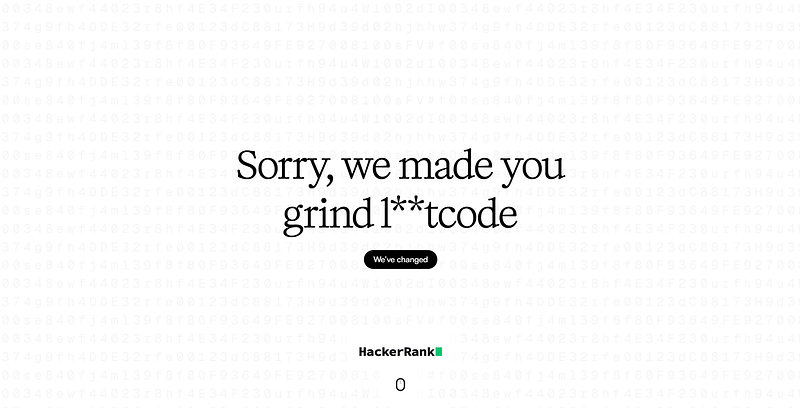 Screenshot taken from HackerRank
AI can help you generate a solution, but understanding why that solution works, whether it's efficient, and how to adapt it to a different problem is still valuable. Strong fundamentals give you a better foundation for working with AI rather than relying on it blindly.
You might also have heard claims that Google has replaced DSA interviews with AI-assisted rounds. That description is very misleading. Reports about AI-assisted interview experiments don't mean traditional algorithmic interviews have disappeared entirely.
The interview process can evolve, but that doesn't make problem-solving fundamentals irrelevant.
So, if you're a beginner wondering whether you should start LeetCode, my answer is: yes, if you approach it as a way to learn rather than simply collecting solved problems.
And that's exactly what I want to share in this blog.
Before You Start — Build Your Foundation
Before diving into problems, make sure you're comfortable with basic programming concepts like loops, conditionals, functions, arrays, and data types. If you're just starting out, consider following a beginner-friendly programming course or tutorial.
Knowing the basic syntax of at least one programming language is a must before you even think about DSA. You don't need to master the language, but you should be comfortable enough to write basic programs without constantly looking up the syntax.
 Image picked from the internet
You also need to pick one programming language to focus on. Some popular choices include Python, C++, Java, JavaScript, and Kotlin. Stick to one language while you're learning so you can focus on problem-solving instead of switching between different syntaxes.
Data Structures & Algorithms
As you might already know, most LeetCode problems involve Data Structures and Algorithms (DSA). To solve them effectively, you'll need to understand both.
Data structures help you organize and store data. Arrays, linked lists, stacks, queues, hash maps, and trees are some common examples.
Algorithms are step-by-step approaches to solving problems. Sorting, binary search, and tree traversal are a few examples you'll encounter while practising DSA.
Now here's the thing: you don't need to learn every data structure and algorithm before starting LeetCode. You can learn them gradually as you solve problems and encounter new concepts.
Start with the basics, understand how they work, and learn when to use them. The goal isn't to memorize every algorithm out there; it's to recognize which approach makes sense for a given problem.
Don't Solve Random Problems — Follow a Roadmap
The first thing that might come to mind when starting LeetCode is to open the LeetCode Problems page and start solving problems one by one.
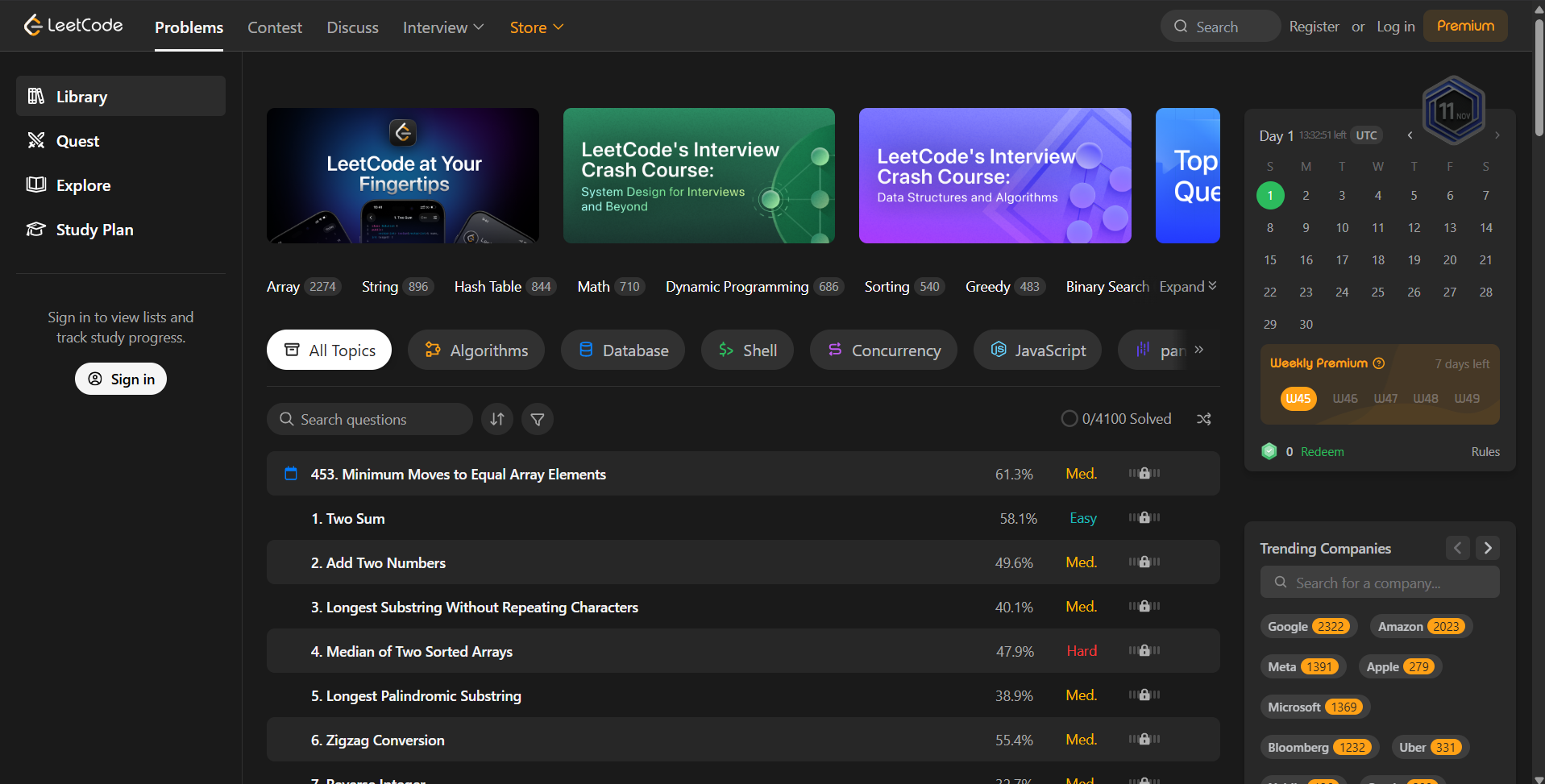 The LeetCode problems page
However, that's not necessarily the best approach, especially when you're just starting out.
Even if you filter for Easy problems, you'll find some that are surprisingly challenging. That's completely normal, but jumping between unrelated problems without understanding the underlying concepts can make learning frustrating and leave you wondering what you're doing wrong.
The problem isn't that you're a beginner. It is that you are trying to solve problems without a structured learning path.
This is where roadmaps come in.
Instead of choosing problems randomly, a roadmap groups them by topic or pattern, allowing you to build your understanding gradually. You'll start recognizing familiar patterns and approaches, and learn how to apply them to new problems.
Here are a few resources worth checking out:
- NeetCode Roadmap — A visual roadmap that helps you understand the major DSA topics and how they connect.
- NeetCode 75 — A curated set of problems covering important patterns. It's a useful starting point if you want a more focused list.
- LeetCode 75 — LeetCode's own study plan covering a range of essential interview topics.
There are many roadmaps available out there. You don't need to follow every single one.
My advice is to pick a roadmap and stick with it.
I started with easier problems and gradually worked my way through medium problems. You can do the same. Don't rush through a list just to increase the numbers; focus on understanding the concepts behind each problem.
How to Approach Any LeetCode Problem
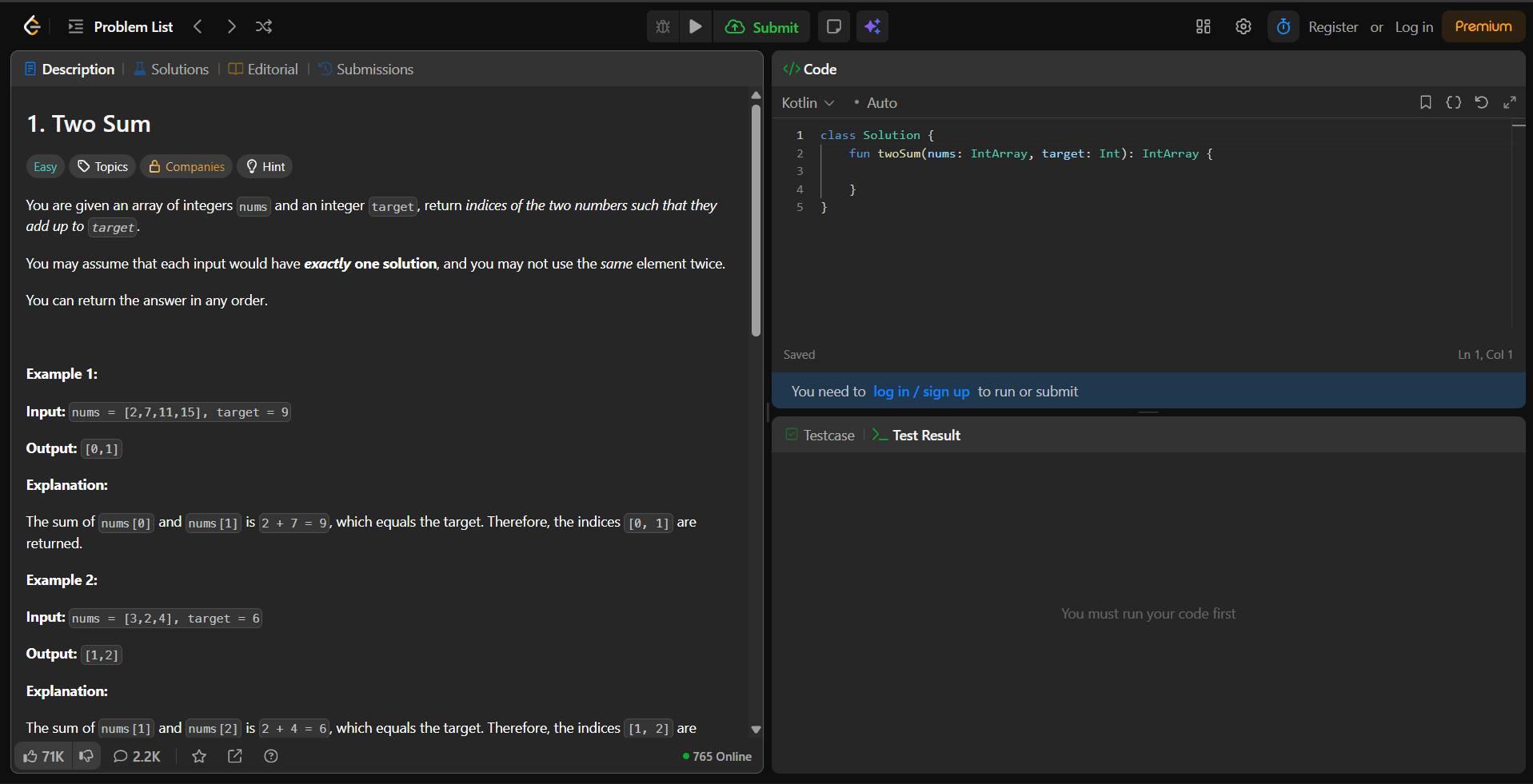 Two Sum on LeetCode
Now that you have picked a roadmap, let's get into the real part: actually solving the problems.
When I first started solving LeetCode problems, I realized that writing code was only the first part of the process. Understanding the question, figuring out an approach, and knowing how to improve it were equally important.
So how should you approach a problem when you first see it?
Let's take the famous Two Sum problem as an example.
1. Understand the Problem Before Writing Code
Here's the problem in simple words:
You're given an array of integers called nums and an integer called target. You need to find two different elements whose sum equals the target and return their indices.
Before writing any code, ask yourself:
- What inputs am I given?
- What exactly am I supposed to return?
- Can I use the same element twice?
- Are there any constraints or edge cases I should consider?
These questions seem basic, but misunderstanding the problem can lead you to write an entire solution that doesn't solve the actual task.
Take your time to actually understand the problem before jumping to the code.
2. Think of a Brute Force Solution
Well, at the beginning all you know are programming fundamentals, and you obviously don't know concepts like linked lists, hash maps, and so on.
You have to start with the simplest solution you can think of.
For Two Sum, we can use two nested loops. The first loop picks an element, and the second checks every element that comes after it to see whether the two numbers add up to the target.
Pick the first number. Check every number after it. If their sum equals the target, return both indices. Otherwise, move to the next number and repeat.
The solution works, but there is a catch.
For an array containing n elements, we may need to check a quadratic number of pairs. Its time complexity is O(n²), while its auxiliary space complexity is O(1).
Can I do it better? That's the question you should ask yourself after finding a working solution.
3. Look for Ways to Optimize Your Solution
Let's think about what we're doing in the brute-force approach.
For every number, we're searching through the remaining elements to find its complement, the number we need to reach the target.
Instead of repeatedly searching the array, what if we could remember the numbers we've already encountered?
This is where better concepts like hash maps come into use.
The lesson here is learning to identify repeated work and finding a data structure that helps eliminate it.
4. Test Your Solution and Think About Edge Cases
Getting the main logic right is important, but you don't have to stop there.
Try different inputs and ask yourself whether your solution still works.
You should also pay attention to the constraints given in the problem. They help you understand what inputs are possible and which approaches are practical.
Once you're confident in your reasoning, submit your solution and see whether it passes.
If it fails, don't immediately rewrite everything. Look at the error or failing test case, identify what your logic missed, and fix the underlying issue.
5. Understand the Solution, Not Just the Submission
Suppose your brute-force solution passes all the test cases. Great! But if an optimized approach exists, it's worth understanding why it works and what trade-offs it introduces.
Similarly, if you can't solve a problem independently, don't spend hours staring at the screen just to prove that you can.
Give yourself a reasonable amount of time to think. If you're stuck, try a hint or study the solution's main idea. Then close the explanation and implement the solution yourself.
Afterward, make a short note of:
- The key idea or pattern.
- Why the approach works.
- Time and space complexity.
- What you missed or found difficult.
Come back to the problem later and try solving it again without looking at your notes.
That's how you turn a solution you once needed help with into something you can eventually work out independently.
Learn Patterns, Not Just Individual Solutions
As you keep solving problems, you slowly get introduced to a pattern.
 Photo by Laurin Steffens on Unsplash
You might encounter two problems that look completely different on the surface but can be solved using the same underlying approach.
That's where recognizing patterns becomes important.
Once you understand a pattern, you can apply that knowledge to other problems instead of figuring everything out from scratch.
But here's the catch: simply knowing that a solution uses two pointers or a hash map isn't enough. You need to understand why that approach works and when it's appropriate to use it.
What Should You Note Down?
Whenever you solve a problem, don't just save the code and move on. Learn to make a few short notes:
- Problem: What was the problem asking?
- Pattern: Which technique or data structure did you use?
- Key insight: What helped you arrive at the solution?
- Complexity: What are the time and space complexities?
- Mistake or lesson: What did you struggle with, and what would you do differently next time?
Over time, you'll build your own collection of patterns and insights that you can revisit whenever you encounter a similar problem.
Remember: the goal isn't to memorize 100 solutions. It's to learn techniques that help you solve problems you haven't seen before.
Consistency Is Always Better Than Mood
 Photo by chris robert on Unsplash
You might solve 10 problems in a single day when motivation suddenly kicks in, only to solve zero for the rest of the week.
Solving seven problems in one day is great. But what if you solved just one problem every day instead? You'd still solve seven problems in a week, while building a consistent habit along the way.
That is the power of discipline.
You have to learn to be consistent rather than relying entirely on motivation. Motivation might give you the energy to go a thousand miles in a day, but consistency is what keeps you moving forward, day after day, until you reach your destination.
Build a routine that you can actually sustain. You don't have to solve five or ten problems every day. Some days, you might solve a Medium problem; on others, you might review an old solution or revisit a concept you struggled with.
The important thing is to keep learning and avoid letting LeetCode become something you only do when you feel motivated.
Remember, you're building a skill, not racing against a deadline.
Conclusion — Measure Progress by Understanding
 Photo by Drew Beamer on Unsplash
DSA still matters in the AI era. Whether you're preparing for technical interviews or simply becoming a better developer, learning to break down problems and think through solutions is a valuable skill.
Start with a programming language, get comfortable with its fundamentals, and gradually work your way into DSA problems. You don't need to understand everything before you begin. Learn as you go, make mistakes, and improve with every problem you attempt.
The number of problems you solve does matter, but understanding matters more than the count. Don't just celebrate solving a problem. Ask yourself why your solution works, whether there's a better approach, and whether you could solve a similar problem on your own.
I solved 100 LeetCode problems in October using Kotlin, and I'm still learning. I don't have all the answers, and that's exactly the point: you don't need to be an expert to start.
Start small. Stay consistent. Focus on understanding. The progress will follow.
About the Author
Hi, I'm Samrat Parajuli, a self-taught Android developer from Nepal. I build native Android applications with Kotlin and Jetpack Compose, and I'm interested in understanding not just how things work, but why they work.
I'm documenting my journey as I learn software development, build projects, solve problems, and grow as a developer. Through my writing, I share what I learn along the way — including the mistakes and lessons that tutorials don't always teach.
If you found this article helpful or relatable, feel free to share your thoughts in the responses. I'm always open to learning from different perspectives.
Connect with me: GitHub · LinkedIn · X · Instagram · Portfolio · LeetCode